


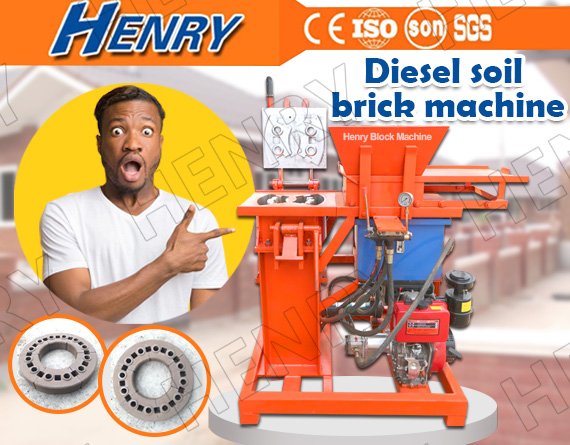


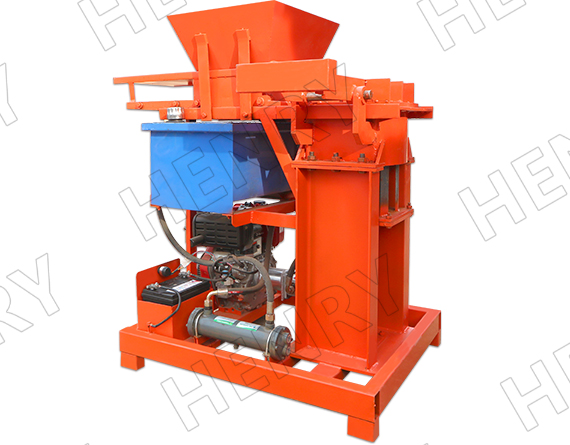

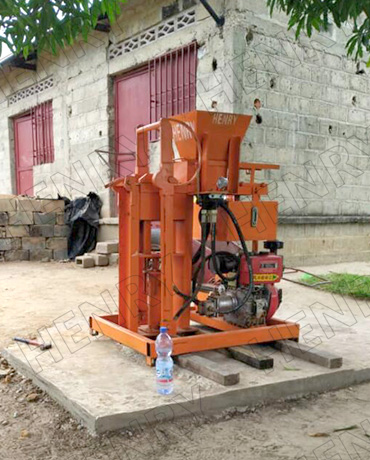
HR2-25 Diesel powered clay brick machine
According to the feedback from customers for many years, the Henry clay brick machine has perfected the design of the fuselage, strengthened the strength of the machine frame, and increased the pressure to 50 tons. In this way, the strength of the bricks is stronger, and the quality is comparable to that of a large automatic Henry clay brick machine.
Obvious advantage
- Diesel engines as power, suitable for places where electricity is scarce
- Easy to operate, no need for any after-use care and maintenance
- The mold is easy to replace, and clay bricks of various sizes can be produced with only one machine
- The price is favorable, and our company has launched the most favorable policy at present
Manual diesel engine powered clay brick machine
HR2-25 is designed especially to be satisfied for some customers who is lack of electricity, but also require to get super-strength clay bricks, because this machine takes use of hydraulic compress.
Powered by a reliable diesel engine, this brick machine is perfect for areas where electricity may be limited or unreliable. With its manual operation, it offers exceptional versatility, allowing you to create bricks in remote locations without depending on external power sources.
Crafted with precision and durability in mind, this clay brick machine is constructed using high-quality materials, ensuring its long-lasting performance even in challenging environments. The machine is equipped with a sturdy frame that provides stability during the brick-making process, allowing for consistent results every time.
Operating the Manual Diesel Engine Powered Clay Brick Machine is a breeze. Simply load the raw clay mixture into the machine’s hopper and engage the diesel engine. The machine’s powerful compression system compresses the clay, forming bricks with uniform shapes and sizes. The manual control system enables you to adjust the compression force according to your desired specifications, allowing for customization and flexibility in brick production.
This brick machine boasts an impressive production capacity, allowing you to manufacture a large number of bricks in a relatively short period. It efficiently converts clay into high-quality bricks, ensuring smooth and efficient workflow, whether you are involved in construction projects, brick production for commercial purposes, or even in the development of sustainable housing initiatives.
Not only does this Manual Diesel Engine Powered Clay Brick Machine offer excellent products, but it also prioritizes environmental sustainability. By utilizing clay as the primary raw material, it minimizes the need for other resources, such as cement or sand, which are often associated with higher carbon footprints. This makes it an ideal choice for eco-conscious builders and those committed to sustainable construction practices.
Invest in our Manual Diesel Engine Powered Clay Brick Machine and unlock the potential for efficient brick production, whether you are a contractor, entrepreneur, or an individual with a passion for sustainable building solutions. Experience the convenience, reliability, and versatility this machine offers, as it empowers you to create durable clay bricks that stand the test of time.
Technical Data
- Tab1
- Tab2
| Overall size : | 1150*910*1650mm |
| Weight of host block machine | 700kgs |
| Host machine rated power | 12 HP |
| Worker number required | 1-2 workers |
| Mold size | 300*150*100mm |
| Compressure force | 20-40 tons |
| Block forming period | 20-25 seconds |
| Applicable industries
| Building Material Shops, Machinery Repair Shops, Manufacturing Plant, Construction works , Compressed Earth Block machine |
| Raw material | Soil , Clay, Earth, Mud, Stone dust, Lime. |
| Block mould | One set for free |
| Mixer model | JS350 soil mixer |
| Belt conveyor machine | 4.5 m length |
| Core Components | Diesel Engine, Bearing, Starter, hydraulic oil horse, Gear, Pump |
| Warranty of core components | 1 year |
| Place of Origin | Shandong |
| Unique selling point | Fully hydraulic system |
| Color | According to the buyer’s requirement |
| Video outgoing-inspection | Provided |
| Machinery Test Report | Provided |
| Condition | New |
| After-sales Service Provided | Engineers available to service |
| Product name | HR2-25 Earth block making machine |
| Quantity/mould | 2 pieces of 300*150*100mm interlocking block |
| Production area required | 100-300 square meters |
| Workshop area | 6 square meters |
| Raw material store workshop | 15 square meters |
| Office | 20 square meters |
HR2-25 diesel engine compressed earth block machine production capacity :

HR2-25 Diesel powered clay brick machine advantages
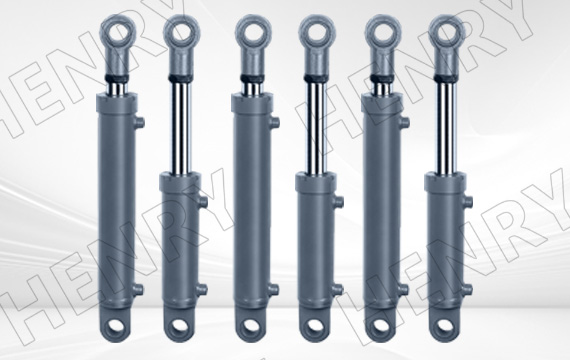
Clay brick machine cylinder
01. Hydraulic cylinder
The circle mark is obvious; never explode the cylinder. Full tonnage, Full stroke, Tight lock, no oil leakage
Clay brick machine Horse
02. Clay brick machine Horse
Steel wire spiral hose Bear high temperature and high-pressure Flange interface sealed well no oil leakageSteel wire spiral hose Bear high temperature and high-pressure Flange interface, sealed well no oil leakage


Clay brick machine Diesel engine
03. Diesel engine
Good atomization, low fuel consumption, more punctual fuel injection Made of special materials long life.
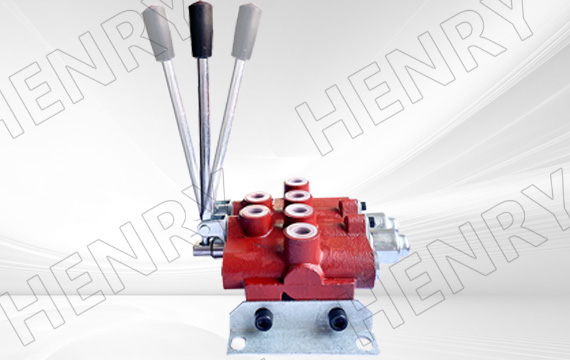
Clay brick machine Reversing valve
04. Operating handle
spring return structure stable performance The control flow is stable, the output is uniform, and the oil intake and oil return stop are accurate
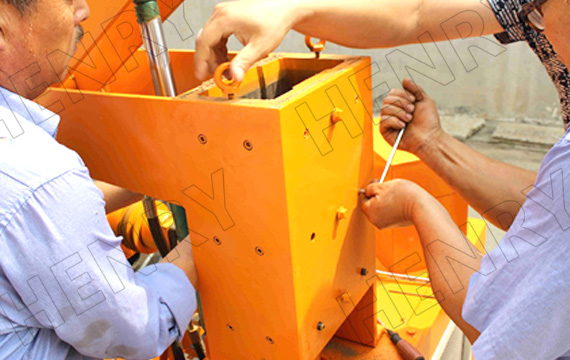
HR2-25 clay brick machine mould box
05. Simple and practical
One machine is multi-purpose, and the fixed wire holes are reserved for changing different molds. The replacement is simple.
Soil brick machine mold
06. Block mold
Carburizing, heat treatment, wear resistance. Wire cutting technology, small error Carbon dioxide protection welding The welding body is firm and does not crack.

HR2-25 Diesel engine clay brick machine advantages







Simple project sections and tips
- Gallery
- Data Shete

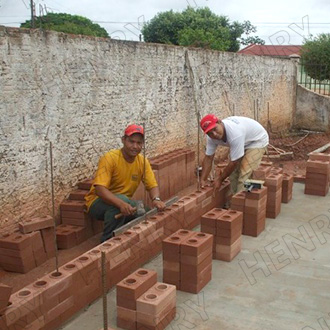

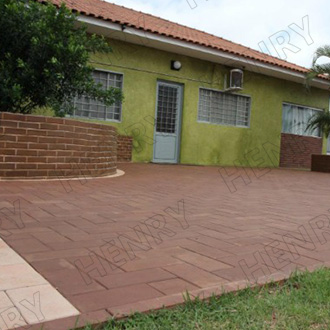


Clay brick samples for clients to choose (6)

Size: 300*150*100mm
Diameter: 50mm
Compressor ratio: 1:1.9
Output: 2 bricks at a time/ 2880 bricks per 8 hours

Size: 300*150*100mm
Diameter: 50mm / Groove depth: 30mm
Compressor ratio: 1:1.9
Output: 2 bricks at a time/ 2880 bricks per 8 hours

Size: 300*150*100mm
Male depth: 15mm
Compressor ratio: 1:1.9
Output: 2 bricks at a time/ 2880 bricks per 8 hours

Size: 300*150*100mm
Diameter: 50mm with any famous logo
Compressor ratio: 1:1.9
Output: 2 bricks at a time/ 2880 bricks per 8 hours

Size: 225*112.5*60/80mm
Logo: it can be designed
Compressor ratio: 1:1.9
Output: 2 bricks at a time/ 2880 bricks per 8 hours

Size: 300*150*100mm
Diameter: 50mm/ square hole :40*40mm
Compressor ratio: 1:1.9
Output: 2 bricks at a time/ 2880 bricks per 8 hours

HR2-25 HENRY clay brick machine test all kinds of earth blocks for customers
- How to choose and compare a interlocking brick press that is suitable for opening a brick starter?
- Kenya U shape ISSB interlocking soil clay earth mud brick molding machine test 50 tons pressure
- Kenya popular clay soil earth interlock brick molding machine at 50 tons strength compression
- Super professional explaining on the clay soil interlocking brick machine of semi automatic diesel
- M7MI twin soil clay brick machine 50 tons pressure test earth hydraform block
How to confirm your final decision on the earth block style
First of all, please tell us which country you are from. Our team will advise customers on the corresponding size and type according to the most used brick types in this market before. Then, customers can ask us to design drawings for them according to their own requirements. Finalize the bricks that the customer wants to produce。

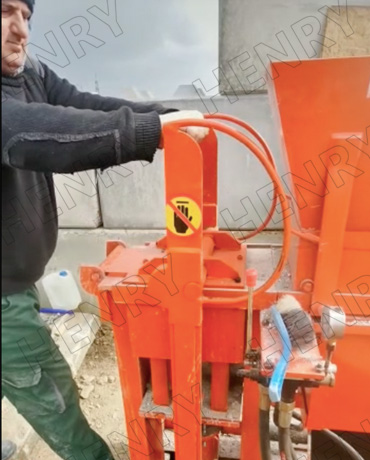
Part of the realistic portrayal of using the Henry Clay brick machine

Necessary equipments for HR2-25 earth block making machine (6)

A soil crusher is for crushing large pieces into small pieces
Soil crusher machine parameters:
Overall size 1500×800×1500 mm Max. Feeding size 300×400 mm Power 5.5kw Capacity(t/day) 7-10T Total weight 320KGS 
A Conveyor machine is for transfer from the crushing machine to the sieve machine
Conveyor machine parameters:
Weight 150KGS Size 4500*700*400mm Motor Power 1.5kw Belt type “V” type Speed 1.5 m /second 
Soil sieve machine for screen raw soil into powder
Soil sieve machine parameters:
Power 0.75 KW Capacity 7-10T/day Hole diameter Diameter:4mm Total weight 350KGS dimension(mm)(L*W*H) 1500×800×1200mm 
A Conveyor machine is for transfer from the sieve machine to the mixer machine
Conveyor machine parameters:
Weight 150KGS Size 4500*700*400mm Motor Power 1.5kw Belt type “V” type Speed 1.5 m /second 
Soil mixer machine is for mixing soil /clay / earth and cement to be good material
Soil mixing machine parameters:
Overall size 1200(L)×1200(W)×1300(H)mm Shaping cycle 2-3 mins Production capacity 8 m3/h Power 5.5KW Volume 350L Total weight 550KGS 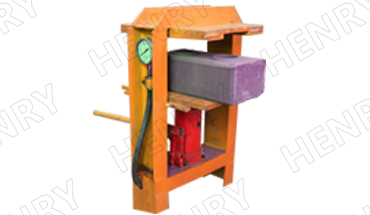
Clay brick tester machine is to test earth block strength
Clay brick tester machine parameters :
Dimmersion 400*300*600mm weight 60kgs Max. Power 55 Mpa Test method manual pressing Cost Free
HENRY Diesel earth Block machines are commonly used to produce compressed earth blocks (CEB) or stabilized earth blocks (SSB). These blocks are made by compressing a mixture of soil, sand, cement (and sometimes other stabilizers, for example, mud and stone powder ) using hydraulic or mechanical presses. The main purpose of using a diesel earth block machine is to manufacture sustainable and environmentally friendly building materials for construction purposes. Earth blocks are popular for sustainable and affordable housing projects because of their low cost, and now, more and more African builders prefer to use earth blocks for building. The machine is powered by a diesel engine, making it especially useful in areas with limited electricity. The engine drives the press, allowing ground blocks to be produced in areas without a steady power supply.
A diesel earth block machine usually consists of several basic components:
Diesel Engine: This is the main power source of the machine. It provides the energy required to drive the hydraulic or mechanical systems responsible for compressing the soil blocks.
Material Hopper: The hopper is where the soil mixture is loaded. It usually has the capacity to hold a certain amount of soil, sand, cement and any other stabilizers.
Soil crushing System: In some machines, there may be a soil crushing system that ensures the soil is properly broken and mixed before compressed . Hydraulic Press or Mechanical Press: This is the heart of the machine and is responsible for compressing the soil mixture into clumps. A compactor uses the hydraulic or mechanical power of a diesel engine to apply pressure to the soil mixture, compacting it into a solid mass. The applied pressure can be adjusted according to the desired block density and strength. Block mould : The press includes a block die that determines the size and shape of the blocks produced. The soil mixture is filled into the mold, and a press applies pressure to compress the mixture and form a block. Block ejection system: After the block is formed in the mold, it needs to be ejected from the machine. There is usually a system for automatically or manually ejecting the blocks to a conveyor belt or other collection area. The process of using a diesel clod machine involves loading the soil mixture into the hopper and then feeding the soil into the crushing system (if applicable). The crushed soil mixture is then transferred to a press where it is compacted into clumps using hydraulic or mechanical force. The chunks are then ejected and collected for curing or further processing
1. Periodic Inspections: Perform a routine visual inspection of the engine and its components, checking for any signs of damage, leaks, or loose connections.
2. Note the engine oil level, coolant level, and air filter condition. Oil Changes: Change the engine oil and replace the oil filter at regular intervals recommended by the manufacturer.
3. Clean oil helps lubricate the engine and prevents excessive wear.
4. Fuel Filter Change: Change fuel filters at recommended intervals to ensure clean fuel flow and prevent contaminants from entering the engine.
5. Air Filter Cleaning/Replacement: Clean or replace air filters regularly, as dirty filters can restrict airflow and affect engine performance.
6. Follow the manufacturer’s guidelines for a recommended maintenance schedule.
7. Cooling system: Regularly check the coolant level and make sure it meets the manufacturer’s specifications. Check the hoses and connections for leaks or any signs of wear. Consider flushing the cooling system regularly as recommended.
8. Battery Maintenance: Check battery connections for corrosion, clean if necessary, and ensure proper sealing. Check the charge of the battery regularly and charge it when necessary.
9. Belt and Hose Inspection: Periodically inspect engine belts and hoses for signs of wear, cracks, or damage. Replace them if necessary to prevent unexpected failure. 10. Regular Maintenance Schedule: Follow the manufacturer’s recommended maintenance schedule for tasks such as valve adjustments, timing belt replacements, and other engine-specific maintenance requirements.
11. Use fuel correctly: Use high-quality diesel and avoid fuel contamination. If the engine will be out of service for an extended period, consider using a fuel stabilizer to prevent fuel from deteriorating. Proper Operating Conditions: Operate engine within recommended load and temperature limits. Avoid excessive idling and ensure proper warm-up before pushing the engine to full load. Scheduled Maintenance by Professionals: Schedule scheduled maintenance and thorough inspections with a qualified diesel engine mechanic. They can detect any potential problems early and help with more complex maintenance tasks
Compressed earth blocks (CEB) are usually made using a mixture of soil, sand and mud. The specific soil type best suited for CEB depends on its composition and properties. Here are some factors to consider: Clay Content: Soils with a higher clay content (around 30-70%) tend to be better suited for CEB because of their better cohesion and binding properties.
secondly,Silt and Sand: Needs a balance of clay content with the right amount of silt and sand. Silt helps improve workability and reduces shrinkage, while sand improves stability and drainage.
Grain Size: It is important to mix soil that contains a variety of grain sizes, including fines (small particles) and coarser materials; this will help achieve better compressing during block production.
Stabilizers: In some cases it may be necessary to add stabilizers such as cement, lime. Especially if the soil does not have the ideal properties for blocks. they can enhance strength, durability and weatherability.
Maybe some buyers worry that whether they need to buy different machines to make different types of earth blocks, in fact, it’s possible to use a single earth brick machine for producing different styles of earth interlocking blocks by changing different molds, and, all of the different molds are easy to be removed and fixed onto machine.
Usually, we configure a high-horsepower diesel engine with 22 horsepower, and even if it is a high-horsepower diesel engine, our diesel engine is designed to save energy consumption. The fuel tank capacity is 8 liters, and our diesel engine can run for 3 hours, while other brands of diesel engines only use 2 hours
 English
  Russian
  Spanish
  Arabic
  French